
Gratiot Release Mugshot Records
A booking photograph records appearance during an agency’s booking process. It does not by itself prove the charge, the outcome, or the date custody ended. Release also does not automatically erase the agency-held image. Michigan FOIA allows a request for an existing public record, but the agency still decides whether the requested image is held, responsive, exempt, or subject to redaction. No source promises that every Gratiot booking photo must be disclosed.
The source label matters. A Sheriff booking image belongs to a Gratiot County Jail event. An OTIS photo is an MDOC identification image and may have a separate image date. A Public Sex Offender Registry photo reflects a registry record. An official agency or news release may use an identification image selected for a particular event. None should be relabeled as the Gratiot jail mugshot without evidence.
A released person normally drops off a current-custody roster. Gratiot publishes no official statement that a name or photograph stays visible for a set time after release. Roster absence also can mean transfer or a data change. Confirm release through the custody record instead of using the photo’s presence or absence as a release test.
Where Gratiot Release Photos Appear
Five official or source-aware channels can surface a photograph. Each covers a different population and time span. Begin with the agency that created the record, then expand only when the person’s custody history supports another source.
| Channel | Photo availability | How to use it |
|---|---|---|
| Gratiot JailTracker roster | May display a current detainee image in the live interface | Use only as a current-roster observation; no released archive or retention promise was found |
| Gratiot County FOIA | A booking image may be requested after release | Identify the person and booking, and ask for the image plus its image date |
| MDOC OTIS | Often shows an offender photo and image date for covered state cases | Use for MDOC prisoners, parolees, probationers, and recent discharges, not county-only custody |
| Michigan public registry | May show a photo for a published registrant | Use only for the statutory registry population; it is not a general release-photo search |
| Official agency or news release | Sometimes includes an identification or booking image | Keep the date, source, and case context; do not treat the image as proof of a conviction or release |
Third-party photo and jail aggregators can also appear in web results. Their correction, source, and retention practices were not verified in the Gratiot research. They can be stale or misattribute an image, so they should not carry the factual burden. No commercial mugshot publisher or removal vendor is linked here.
Note: A photo found in one system should be described by that system’s name and image date, not as a universal booking record.
Gratiot Roster Photo Limits
The official Gratiot JailTracker roster is a client-rendered current-custody tool linked by the Sheriff. The county calls it an inmate roster. Research found no official 24-hour or 72-hour released view, no separate photo archive, and no published rule for how long an image remains after custody ends. If the live interface shows a picture, record that it was associated with a current roster entry at that time.
Disappearance is only a lead. A person may have been released on bond, discharged by court order, completed a local sentence, entered monitored release, or transferred to MDOC, another jail, federal authority, or immigration custody. Call the Jail Division and request the custody disposition when the exact event matters. The Gratiot 24-hour jail release route explains the direct-call, court, notification, and records fallback created by the missing feed.
No official Gratiot Sheriff inmate app was found. The county’s emergency “Gratiot Safe” app is not documented as a jail lookup, release feed, or booking-photo tool. No official Sheriff social stream was found that systematically publishes releases or booking images. These are specific negative findings, not claims that no future service can exist. Recheck the Sheriff source rather than substituting an unrelated app.
Request a Gratiot Booking Photo
County FOIA is the durable route after a person leaves the live roster. Michigan FOIA begins at MCL 15.231. The general response structure is five business days, with one extension of up to ten business days. Allowed costs can include defined labor, duplication, and mailing. Paper duplication is generally capped at ten cents per standard page, while the county’s policy governs estimates, deposits, electronic delivery, and itemization.
- Open the Gratiot County FOIA page and use the county request form.
- Identify the person by full name and date of birth, then give a narrow booking-date range and booking number if known.
- Ask for the existing booking photograph and its image date. State that an electronic copy is acceptable if that fits the request.
- Ask separately for the custody record if release date, time, disposition, or transfer information is also needed.
- Review the county response for the record provided, any redaction or exemption, and an itemized fee determination.
A booking image and a release record answer different questions. Asking for both in distinct terms helps the FOIA Coordinator locate existing material without requiring creation of a custom report. The county can withhold or redact material when a lawful exemption applies. Juvenile, victim-identifying, investigative, medical, and security-sensitive information can receive special treatment.
Court records use a different access rule because Michigan’s judiciary is excluded from the FOIA definition of a public body. A court file may explain a bond, dismissal, sentence, or set-aside, but the clerk is not the custodian of the Sheriff’s booking image merely because both records concern the same case. Send the photo request to the county FOIA route and any judgment-copy request to the correct court.
The official Gratiot records page shows the county’s request route.
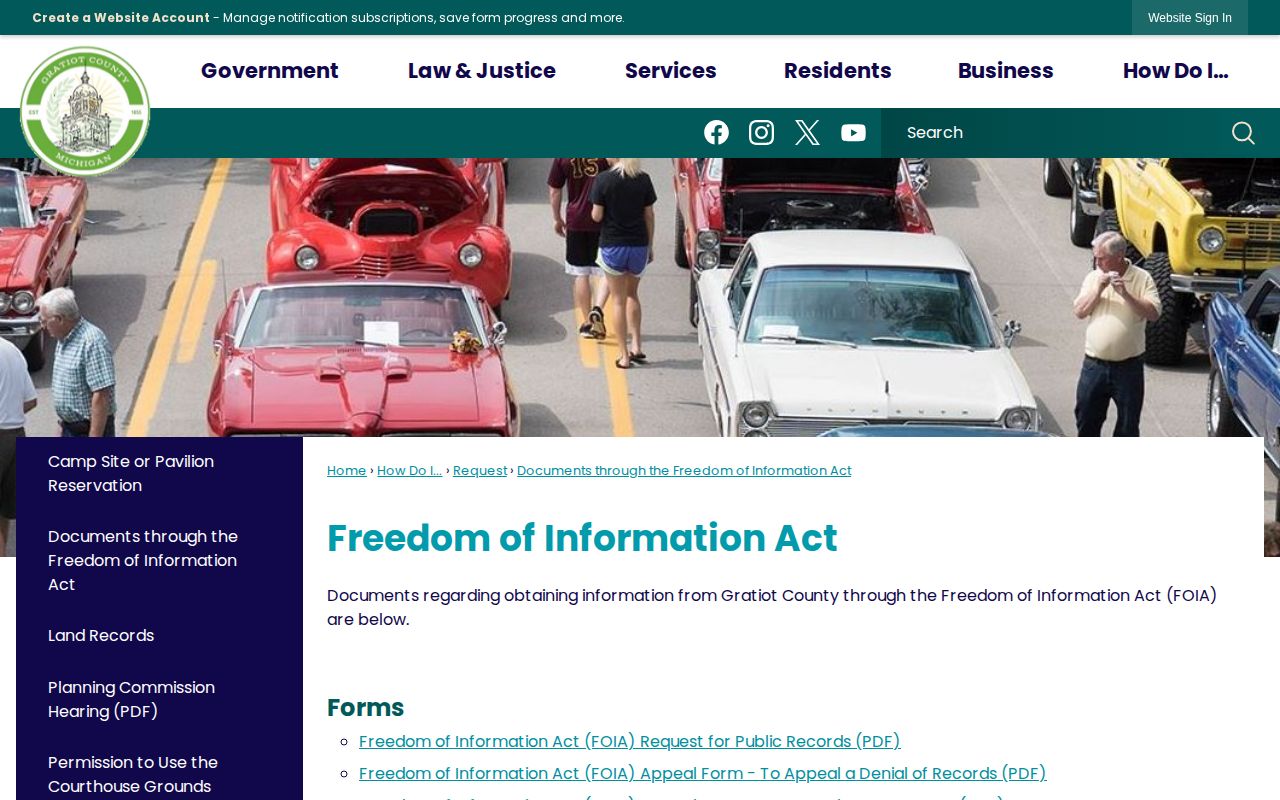
Use that page for a Sheriff-held booking photo, while court copies and MDOC images remain with their own agencies.
Gratiot MDOC Release Photos
Michigan OTIS often shows a photo and image date for people under MDOC jurisdiction. It covers prisoners, parolees, probationers, absconders, and people within the public post-discharge period. It does not cover a person whose only custody was the Gratiot County Jail. That boundary is especially important because Central Michigan Correctional Facility and St. Louis Correctional Facility are state prisons physically located in Gratiot County.
Search by MDOC number where possible. Otherwise, use the last name and confirm the match with aliases, birth data, physical description, marks, sentence rows, and court file. The displayed picture is an MDOC identity image. It may not have been taken at either Gratiot prison, and it is not evidence of a Gratiot Sheriff booking. Read the photo date and current status separately.
OTIS generally retains a profile for three years after supervision discharge. A record may also leave the public system after a set-aside. An older missing profile therefore does not show that no image or MDOC record ever existed. MDOC records or the sentencing court provide the older-case path. The Michigan Public Sex Offender Registry is a separate limited channel and should not be treated as an OTIS substitute or a universal release locator.
Context for Gratiot Mugshot Sources
Official Sheriff, prosecutor, police, MDOC, and local news releases sometimes reproduce a photograph when a case is newsworthy. Search the exact person’s name with the agency name. Preserve the publication date and the words the source used. An arrest image does not establish guilt, sentence completion, or release. A later article may discuss a court ruling while still using an older booking picture.
Source age matters too. A current OTIS photo can differ from the county booking image. A registry picture can be newer than both. A copied image with no agency label loses the facts needed to evaluate it. When preserving a record for personal knowledge or a court process, save the source page, date accessed, image date if shown, and the person identifiers used for the match.
VINELink is useful for custody notifications, but it was not documented as a stable historic Gratiot booking-photo archive. A release or transfer alert should send the reader back to the reporting agency’s record. It cannot convert a current image into a permanent release photograph.
Gratiot Expungement and Mugshots
Gratiot maintains a local expungement information page that directs readers to Michigan guidance and Legal Services of Eastern Michigan. Michigan’s set-aside framework begins at MCL 780.621. When a conviction is validly set aside, public court or OTIS information can become nonpublic or be removed from the public search. A missing result can also come from retention rules, spelling, or another custody system, so absence does not prove that no case or incarceration existed.
MCL 764.26a provides removal or correction mechanisms for certain arrests without charges or dismissed proceedings. It is not a universal mugshot-erasure rule. Research found no broad Michigan anti-pay-to-remove mugshot statute that can responsibly be claimed here. A person seeking correction should begin with the official agency holding the image and the court order or legal provision that supports the request.
Do not pay an unverified removal service based on a claim that it controls an official government record. An agency-held photo, an OTIS image, a registry record, and a copied news image have different correction routes. The court’s set-aside order may affect public access, but each publisher or agency must evaluate its own record and legal duties.
Note: Keep the set-aside order and agency response with the image record because search-result changes alone do not explain why a photo disappeared.