
Gratiot Parole and Probation Compared
Parole and probation both permit a person to live outside a secure facility under rules, but they begin in different ways. Michigan parole is release from an MDOC prison into supervision. The person has physically left prison but remains in MDOC legal custody. Probation is imposed by a court. It can replace incarceration, follow a local jail term, or accompany another sentence. A probation entry therefore does not prove that the person ever served time in a Michigan prison.
The sentencing and custody records resolve the distinction. For parole, look for an OTIS status of Parolee and read the Date Paroled with the sentence rows. For probation, identify the sentencing court and supervising unit. Gratiot felony probation is linked to the 29th Circuit and MDOC field supervision. District probation covers cases handled at the district level. A Gratiot jail roster cannot establish either status after the person leaves the jail.
| Question | Parole | Probation |
|---|---|---|
| How it begins | Physical release from an MDOC prison under a Parole Board order | A community-supervision sentence ordered by a court |
| Main authority | Michigan Parole Board and MDOC Field Operations Administration | Sentencing court, with the assigned probation office or MDOC agent |
| Best public check | OTIS status, Date Paroled, and supervision location | OTIS for MDOC cases plus the Gratiot court and probation office |
| End point | Discharge from MDOC jurisdiction, not merely departure from prison | Court or agency discharge after the ordered term and conditions end |
- Parole
- Release from prison while MDOC custody and supervision continue in the community.
- Probation
- Court-ordered community supervision that does not always follow a prison term.
- Discharge
- The formal end of supervision or MDOC jurisdiction for the relevant sentence.
- Absconder
- A person reported as having stopped complying with required supervision contact, not a person successfully discharged.
Check Gratiot Post-Release Supervision
The Michigan OTIS offender search is the first public check for an MDOC parolee, probationer, or absconder. Search by MDOC number when it is known. That number is a better match key than a name. Otherwise, use the last name and refine the result by first name, age, sex, race, status, or identifying marks. Select All, Parolees, Probationers, or the relevant absconder filter instead of limiting the search to prisoners.
- Open OTIS and search for the person by MDOC number or a well-matched name.
- Compare identity fields, aliases, sentence rows, county, and court file before relying on the result.
- Read Current Status, Date Paroled, and the supervision location together. A prison location means the person is not confirmed released from state custody.
- Use the court file to identify whether the case belongs to Gratiot district or circuit court.
- Contact the listed supervising office when current reporting status or an office assignment needs direct confirmation.
A released county-jail detainee may never appear in OTIS. In that case, use the Sheriff custody record and the appropriate Gratiot court. Likewise, an OTIS parole record does not show a county jail release. Central Michigan Correctional Facility and St. Louis Correctional Facility are state prisons in Gratiot County, so their releases belong to MDOC even when the physical prison address is local. The Gratiot County released-inmate search separates these county and state paths.
The MDOC parole and probation overview shows the state supervision framework. This official view helps distinguish state authority from a local court office and from the county jail.
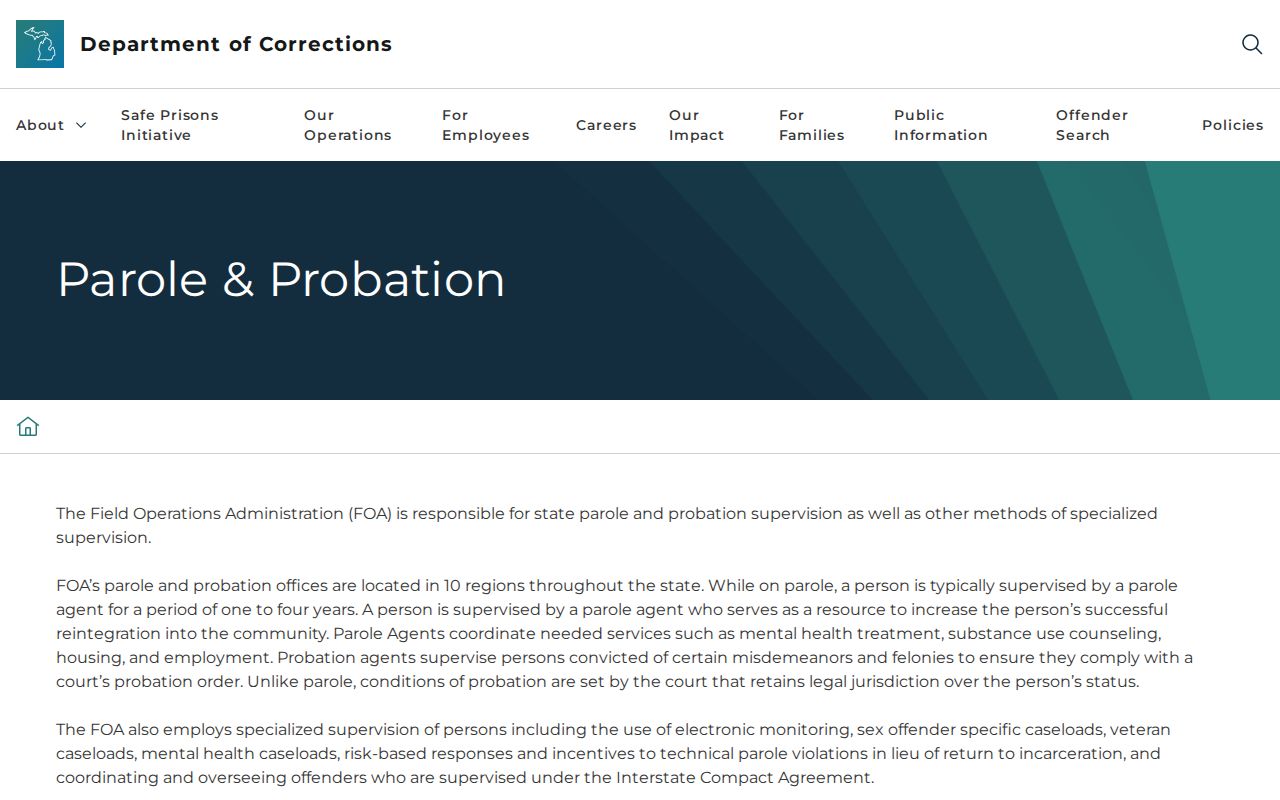
Use the statewide page to identify the agency role, then rely on OTIS and the local office for a person-specific Gratiot County supervision check.
Note: OTIS generally retains discharged profiles for three years after supervision ends, so an older missing record needs an MDOC records request.
Gratiot Probation Office Contacts
Gratiot County has more than one probation path. Circuit Court Probation prepares presentence reports and supervises felony probation compliance while working with MDOC, the courts, jail, and Sheriff. District Probation handles district-court supervision. An office can clarify its own assignment, but it should not be asked to certify a jail-door release time or a state prison release that belongs to another agency.
Circuit Court Probation
114 S. Main Street
Ithaca, MI 48847
Phone: 989-875-5229
District Probation
214 E. Center Street
Ithaca, MI 48847
Phone: 989-875-5243
Hours: Weekdays, 8 a.m.–noon and 1–4:30 p.m.; other times by appointment
The county publishes separate pages for Circuit Probation and the District Probation Division. Match the office to the court record rather than choosing one from the charge label alone. A felony begins in district court for preliminary stages but moves to the 29th Circuit after bindover.
The official District Probation page illustrates the local office and schedule used for Gratiot County district supervision.
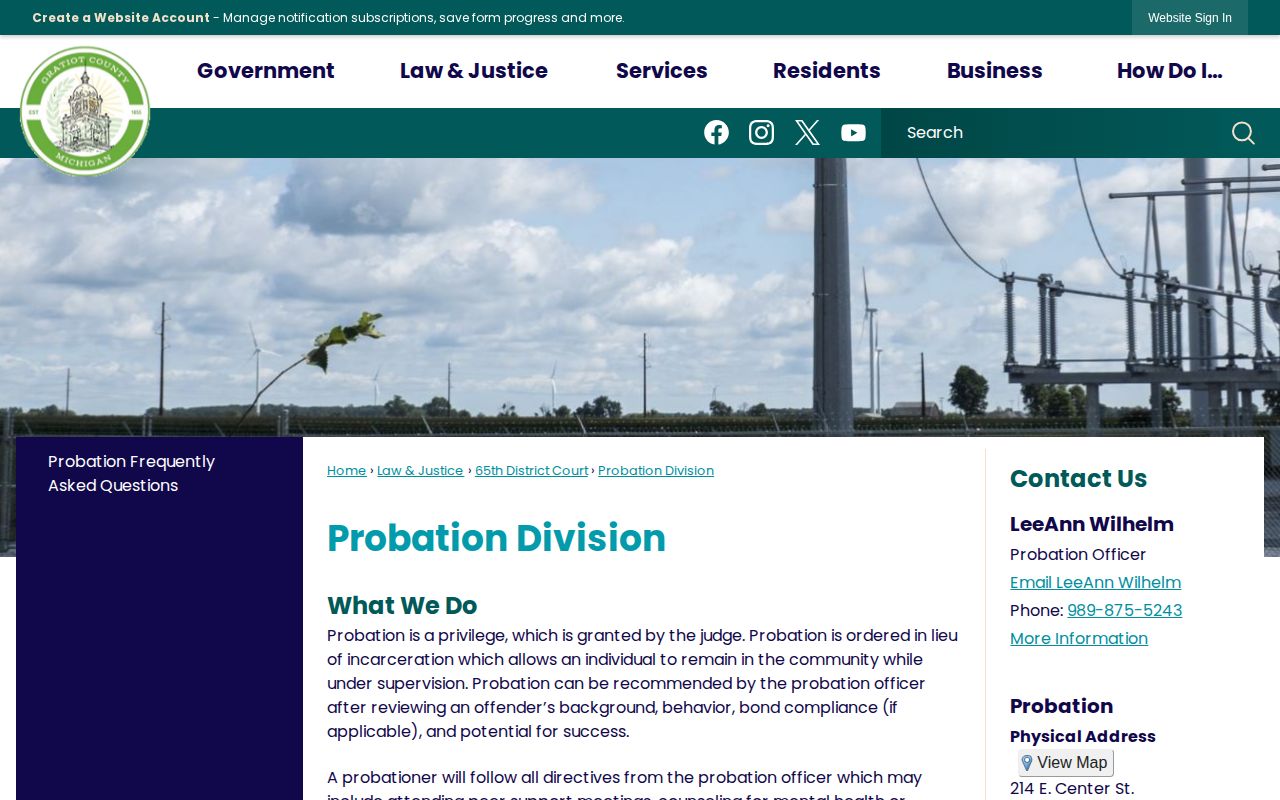
Its local role is distinct from the Parole Board, MDOC prison records, and Circuit Court Probation.
Gratiot Monitored Release Programs
Gratiot’s Office of Community Corrections creates a locally important middle state between a jail cell and unrestricted freedom. The office serves courts across the 29th Circuit and supports the Sheriff with a jail-overcrowding alternative. A person can leave the Gratiot County Jail on electronic monitoring and remain on house arrest. Permission is required for authorized activities. Roster disappearance in that setting reflects physical departure, not completion of the criminal case or all supervision.
The office also provides pretrial services. Participants pay daily equipment fees, though Gratiot publishes no one universal amount. Regional mental-health and sobriety courts add structured court-supervision paths for eligible participants. Those programs may shape where someone lives, reports, or receives services after release, but they are not person-search databases. Confirm participation through the court and the supervising office.
Office of Community Corrections
214 E. Center Street
Ithaca, MI 48847
Phone: 989-875-5316
Hours: Weekdays, 8 a.m.–noon and 1–4:30 p.m.; other times by appointment
The official OCC page captures this Gratiot County monitored-release route.
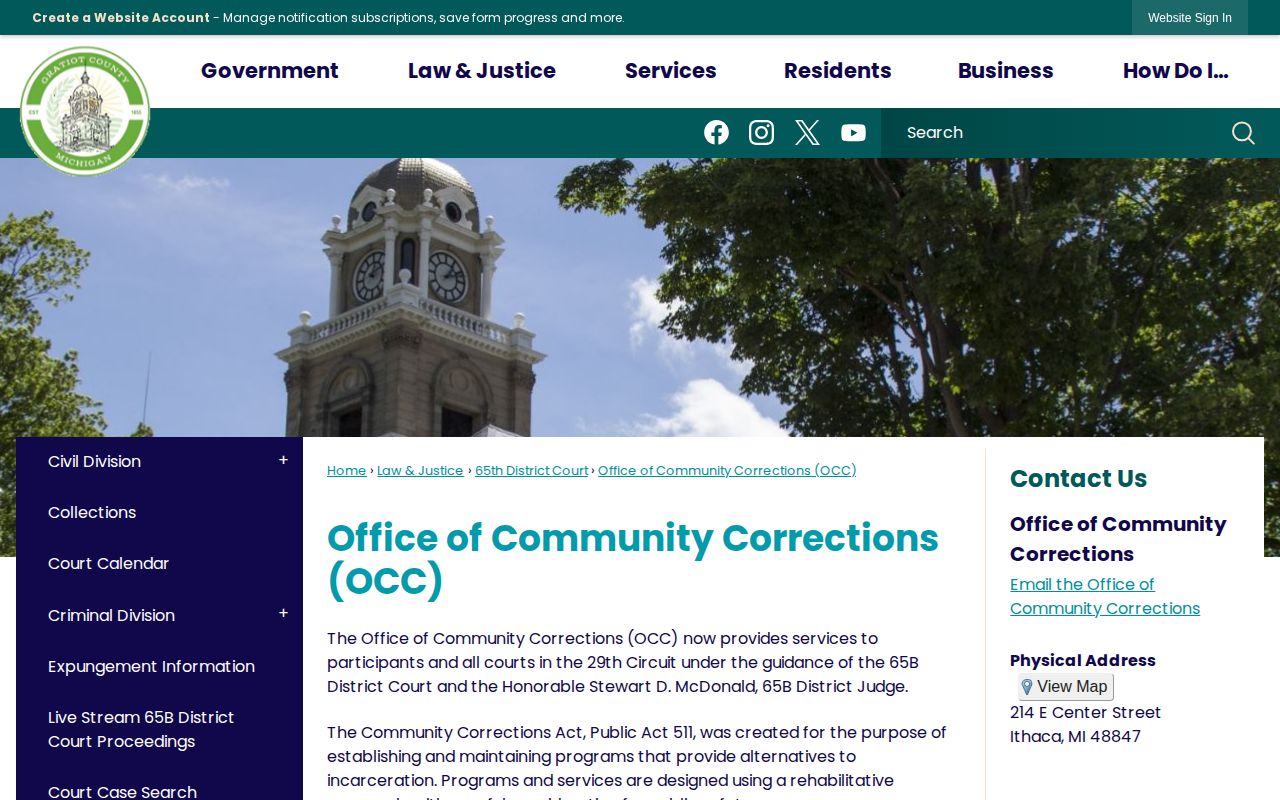
The page supports a key local conclusion: community placement can follow jail departure while strict court controls remain in force.
Gratiot Supervision and Absconders
OTIS separates Parole Absconders from Probation Absconders. Its glossary describes ABSCOND1 as a parolee who failed to report and is actively sought by MDOC. ABSCOND2 identifies a probation absconder under the sentencing county’s jurisdiction. These labels are active status signals. They must not be treated as proof of discharge or successful completion.
When an absconder result appears, verify the identity and the assigned office. The appropriate agency controls any current instruction. Gratiot research found no county person-level warrant or absconder list, so the absence of a name from a local web page proves nothing. OTIS is the public state-supervision check. The sentencing court docket can add case events, but an online docket is not a live field-agent report.
General conditions can involve reporting, approved residence, movement limits, treatment, or other terms fixed by the order. Conditions vary by case. A public profile cannot safely supply every rule. Direct questions about one person’s reporting location or status to the assigned office without assuming that a violation automatically caused a return to prison.
Note: A transfer, violation inquiry, or pending warrant can change the practical custody picture even when the last public result still says parole or probation.
Gratiot Parole Hearing Records
The Michigan Parole Board is the sole paroling authority for felony offenders committed to MDOC. A three-member panel decides by majority. Yet Michigan does not publish one conventional calendar containing every routine prisoner interview. The official public hearing registration calendar covers publicly noticed parole, lifer, pardon, and commutation hearings. These special hearings are not the full routine docket.
MDOC says person-specific hearing notices generally appear about two weeks to 30 days before the hearing, and registration closes two business days before. A notice of “possible parole” shows that consideration is pending. It does not show a grant or actual release. Aggregate quarterly reports count grants, denials, and deferrals, but they are not a person-level outcome search.
For a person-specific result, return to OTIS and look for Date Paroled. A grant can precede placement review, amendment, rescission, or the actual prison exit. When agency documentation is needed, contact the Michigan Parole Board at 517-373-0270 or Parole-Board-Staff@michigan.gov during weekday business hours. Do not use the Board as a county jail release desk.
Gratiot Supervision Discharge Records
Supervision ends through a formal discharge, not merely the passage of an expected date. OTIS may show a Discharge Date after parole or probation ends. MDOC also defines discharge broadly enough to include maximum discharge without parole and death before sentence completion. Read Current Status, the discharge field, and the sentence context together before drawing a conclusion.
For a profile older than the public three-year window, request existing records from MDOC. A discharge certificate or custody history can give stronger documentary support. The sentencing court may also hold an order tied to probation completion. Michigan FOIA generally gives a public body five business days to respond, with one permitted extension of up to ten business days, but disclosure and any redaction depend on the record.
Release alerts do not replace discharge records. MI-VINE can report a custody event where the agency participates, but it is not a long-term supervision archive. The final check should match the record to its owner: Sheriff for a Gratiot jail exit, MDOC for state parole or discharge, and the sentencing court for probation orders.