
Gratiot Projected and Actual Release
Michigan OTIS uses more precise terms than the common phrase “projected release date.” Its key sentence fields include Earliest Release Date and Maximum Discharge Date. The earliest date marks the point at which the Parole Board first obtains jurisdiction under the applicable sentence rules. It does not reserve a release slot. The maximum date is the outside sentence endpoint if parole does not occur earlier, subject to the law that applies to that sentence and any other custody authority.
Actual release is an event. For a state prisoner, Date Paroled is stronger public evidence that the person physically left prison on parole. Parole still leaves the person under MDOC supervision. Discharge Date concerns the end of MDOC jurisdiction for that sentence, and MDOC’s definition also includes death before sentence completion. A new Assigned Location can simply show a prison transfer. None of these fields should be collapsed into one generic “gets out” date.
A Gratiot County Jail detainee follows another path. A person held before trial often has no computed release date. A bond order may authorize release after conditions are met, yet processing or another hold can prevent departure. A person serving a local sentence may have a computed date, but Gratiot has not published a local formula or public calculator. The jail record and judgment are the sound sources.
Find a Gratiot Release Date
Begin with the last custodian. Central Michigan Correctional Facility and St. Louis Correctional Facility are MDOC prisons, despite both being physically in Gratiot County. Their sentence and parole fields appear in the state system. Gratiot County Jail is a Sheriff facility. Its local sentences and pretrial cases do not gain an OTIS date merely because the jail is in the same county.
- Identify whether the person is at the Gratiot County Jail, an MDOC prison, another county jail, federal custody, or immigration custody.
- For an MDOC case, open the OTIS offender search. Use the MDOC number if known, or search by last name and refine the match.
- Verify identity through aliases, birth details, physical description, sentencing county, court file, and sentence rows.
- Read Current Status, Assigned Location, Earliest Release Date, Maximum Discharge Date, Date Paroled, and Discharge Date as separate fields.
- For a county case, obtain the judgment from the correct Gratiot court, then ask the Jail Division for the computed custody date and any hold or transfer.
- Confirm the event after it occurs through the releasing agency’s record. A current roster disappearance alone is not proof.
The official OTIS field glossary supplies the meanings and public-record limits behind this method.
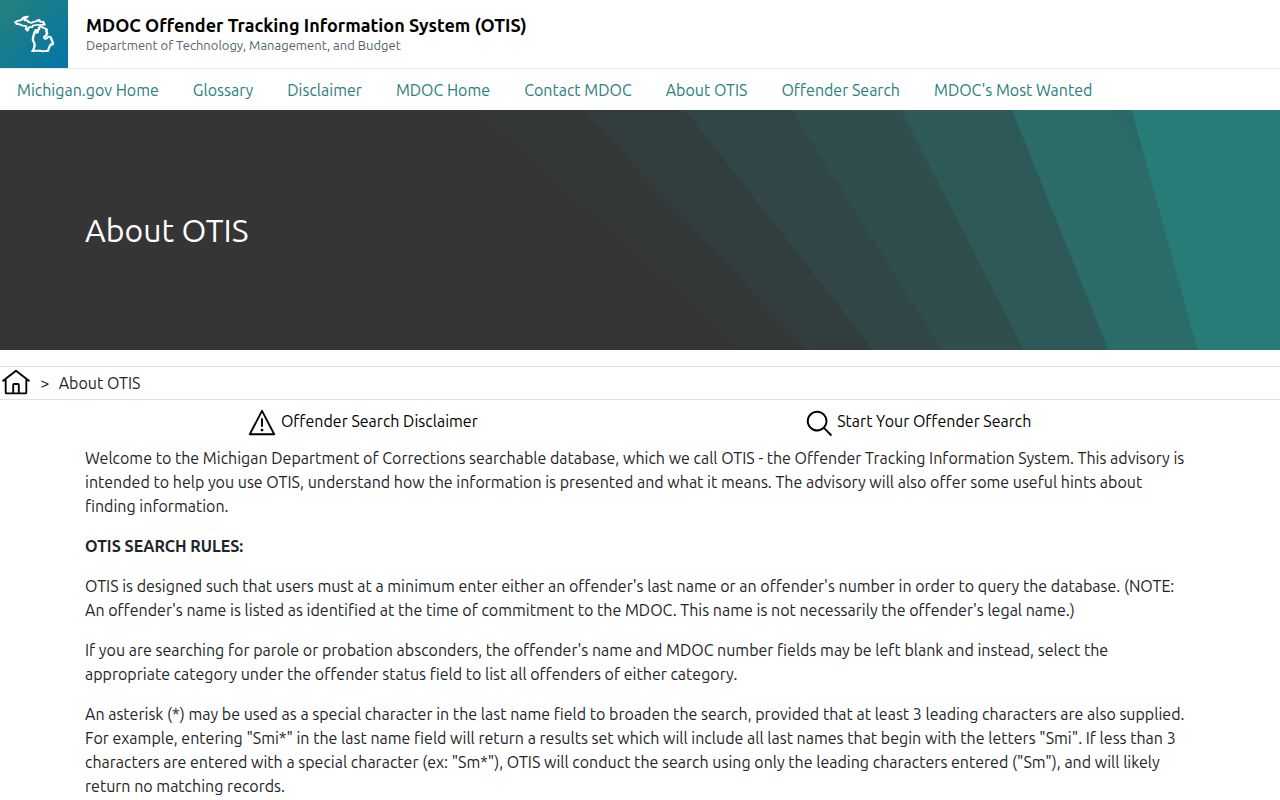
The glossary is essential because a date label can represent eligibility, parole, maximum sentence reach, or discharge rather than one scheduled exit.
OTIS generally includes current offenders and people discharged within three years. It omits county-jail-only cases and may remove a record after a valid set-aside. If an older state record is missing, request a custody history or discharge certificate from MDOC and check the sentencing court.
The Gratiot released-inmate lookup gives the broader custody-specific search sequence when the last agency is uncertain.
Note: A zero OTIS result can reflect county-only custody, a retention limit, a changed name, another jurisdiction, or a set-aside rather than release.
Gratiot Prison Release Landmarks
Michigan uses indeterminate sentencing for most prison terms. A judge sets the minimum within the law, while the offense statute supplies the maximum. The Parole Board first gains jurisdiction at the lawful minimum, less only those legacy credits that actually apply. OTIS calls that point the Earliest Release Date. Eligibility allows review. It does not compel the Board to grant parole under MCL 791.233.
MCL 791.234 governs parole jurisdiction and contains special rules for life sentences and excluded categories. A life sentence cannot safely be reduced to the ordinary minimum-and-maximum explanation. The judgment, offense, and applicable statutory provision control. A public date should never be recalculated from a news report or sentence length alone.
The Parole Board may grant, deny, or defer review. Policy also permits an order to be amended or rescinded before physical release. Placement investigation and other approval work may follow a grant. That is why a hearing notice, eligibility date, or even a grant announcement is weaker proof of release than the later Date Paroled field and the MDOC custody record.
Public hearing information supplies context, not a universal schedule. Michigan posts special parole, lifer, pardon, and commutation hearings through its registration calendar. Person-specific press notices generally appear about two weeks to 30 days before a listed hearing, and attendance registration closes two business days before. Routine prisoner interviews do not all appear on that calendar. Quarterly Parole Board reports are aggregate counts rather than a database of individual outcomes.
When a notice says “possible parole,” the decision is still pending. The Board acts through a three-member panel by majority, and the later case can be granted, denied, or deferred. For one person, match the hearing notice to the MDOC number, sentence, and county, then return to OTIS for the resulting status. Contact the Board for its own record when needed, but do not ask it to predict a prison gate time.
Michigan Credits and Gratiot Release
Michigan truth in sentencing is not a blanket rule that every prisoner serves 85 percent. The law focuses on service of the judicial minimum for covered offenses. MDOC states that specified assaultive offenses committed on or after December 15, 1998, and other covered offenses committed on or after December 15, 2000, require service of the minimum without good-time or disciplinary credits. MCL 791.233b addresses secure-facility service and those credit limits.
Older sentences can involve good-time or disciplinary credits under MCL 800.33. The offense date and statutory class matter. When legacy credits apply, misconduct and a warden’s award can affect the applicable maximum date. OTIS notes that an earliest date can change with misconduct when credits are available. No safe calculation can ignore the offense date, jail credit, concurrent or consecutive terms, and the exact sentence law.
The MDOC parole consideration explanation shows how eligibility fits the truth-in-sentencing structure.
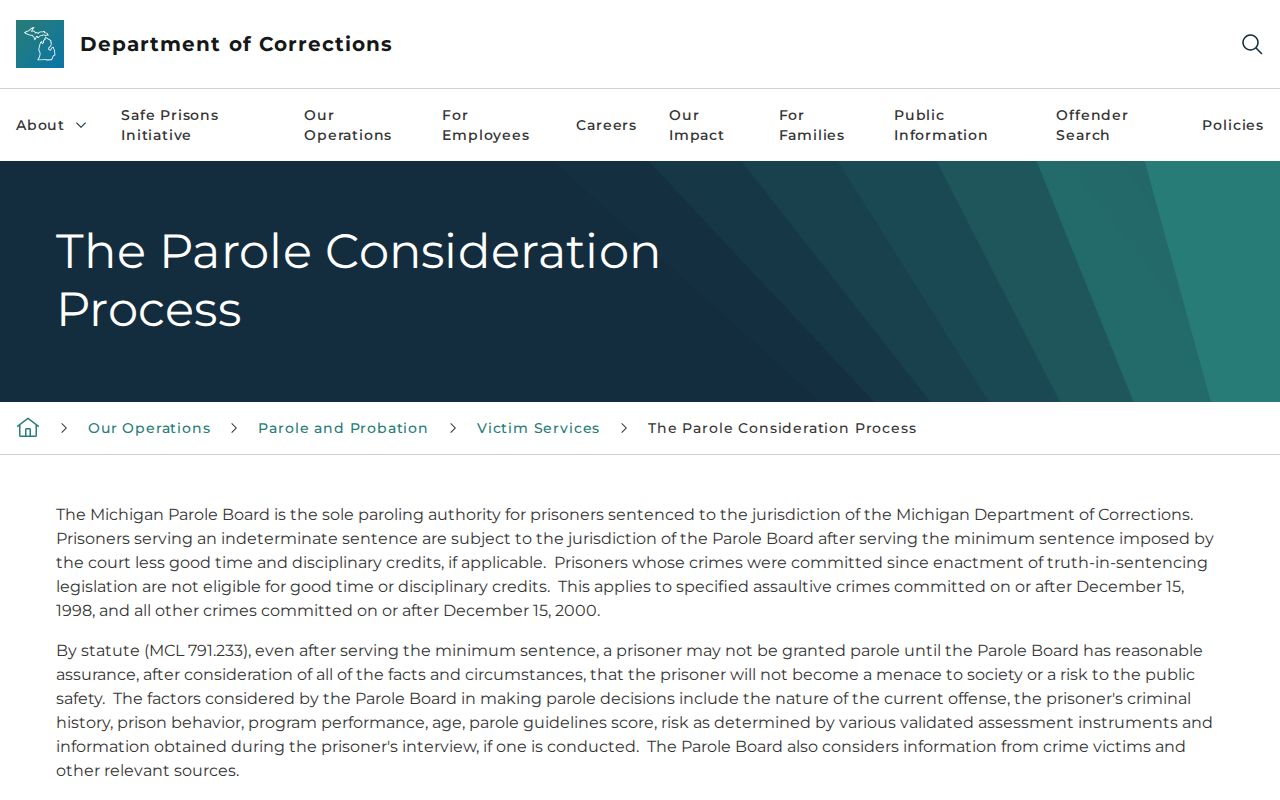
This source reinforces the key limit: reaching the legal review point is not the same event as walking out of a prison.
Why Gratiot Release Dates Change
A date can move because the underlying legal or custody facts change. Some changes alter sentence computation. Others leave the sentence alone but prevent release into the community. The agency record should reveal which type occurred.
| Factor | Effect on the date or event | Best confirmation |
|---|---|---|
| Parole decision | The Board may grant, deny, defer, amend, or rescind; eligibility does not guarantee departure | OTIS Date Paroled and MDOC record |
| Legacy credit change | Misconduct or authorized credit treatment can affect a date where older credit law applies | OTIS, sentence file, and MDOC computation |
| Court order | Resentencing, corrected jail credit, or another order can alter the lawful calculation | Certified judgment or later court order |
| Consecutive sentence | One term may have to follow another instead of running at the same time | Judgment and MDOC sentence rows |
| Detainer or warrant | The releasing agency may transfer the person rather than release them into the community | Custody disposition and receiving agency |
| Institutional transfer | A new Assigned Location changes the prison, not release status | OTIS location and Current Status |
An ICE detainer offers a clear example. A person can leave Gratiot or MDOC custody and move into immigration custody. A state or county release date then records one agency’s custody end, not unrestricted community release. The same principle applies to another county, federal authority, or an unresolved sentence.
Note: Pair a release date with its agency and disposition so two consecutive custody events are not mistaken for conflicting records.
Gratiot Jail Release Calculations
OTIS does not calculate a Gratiot misdemeanor jail release. Start with the 65B District Court for misdemeanors and felony preliminary stages. The 29th Circuit Court holds the felony judgment after bindover. Obtain the judgment, identify credit for time already served, and determine whether terms are concurrent or consecutive. Then ask the Gratiot County Jail for its existing computed release or custody record.
Gratiot has not published an official county-jail good-time formula, weekend adjustment, Sunday-to-Friday rule, or holiday-release practice. Do not borrow a policy from another Michigan county. The 24/7 Jail Division at 989-875-5211 can address immediate custody questions. A durable request can ask for admission, booking number, release date and time, release disposition, and any transferring agency, though the county does not promise that all fields sit in one document.
Bond cases differ from sentence calculations. The Sheriff’s official page links an electronic bond-payment route, but payment can precede court review, jail processing, or resolution of another hold. A bond order and payment are inputs. The actual Sheriff custody record confirms when departure occurred.
A county records request can ask for existing fields rather than demand a new calculation. Useful terms include admission date, booking number, custody-end date and time, release disposition, transfer destination, and the court-order or bond reference if maintained. Michigan FOIA does not require the Sheriff to create a custom release calendar. The response may instead supply several records that must be read together with the judgment.
Confirm a Gratiot Release Event
Use two sources when the event matters. For a state prisoner, pair OTIS Date Paroled or Discharge Date with MDOC documentation when needed. For the Gratiot County Jail, pair the Sheriff release record with the court order that explains the legal basis. A court disposition alone does not supply the jail-door timestamp.
MI-VINE can add a prospective alert where the reporting agency participates. Gratiot County Jail participation was not conclusively documented on a static official page, so test the live agency search or call the service before relying on an alert. For a state prisoner, the MDOC tier can provide a general release notice. The Gratiot VINELink inmate search explains registration and the event-status limits.
A projected release date is most useful when labeled honestly. Preserve the exact OTIS field name. State whether the person is in county, state, federal, or immigration custody. Then update the record only after the responsible agency reports the actual event.