
Understanding Gratiot County Releases
A Gratiot County release can mean physical departure from the county jail, departure from a state prison on parole, or the end of an agency’s legal authority. Those are separate events. The Sheriff records an exit from Gratiot County Jail. The Michigan Department of Corrections records parole and discharge for people under state jurisdiction. A court supplies the order, sentence, bond, or dismissal that may explain why the jail acted. No single database combines all three records.
A person also may leave one building without entering the community. Transfer to another jail, MDOC, federal custody, or immigration custody removes the name from the first facility’s roster. By contrast, release on bond or a court order can return the person to the community, sometimes with supervision. “Parole” means physical release from prison with MDOC supervision still in force. “Discharge” means MDOC jurisdiction for that sentence ended, though the agency definition can also reflect death. Dates and context must be read together.
- Time served
- A sentence satisfied by the custody time already credited by the court.
- Transfer
- A move between custodians, not release into the community.
- Parole
- Release from prison while the person remains under state supervision.
- Probation
- Court-ordered community supervision that may be imposed without a prison term.
- Discharge
- The end of MDOC jurisdiction for the sentence shown, interpreted with the status and date.
How Gratiot County Releases Occur
The legal basis and the next custodian determine which Gratiot County release record matters. A bond payment can start processing, while a court order supplies authority. Completion of a local sentence is documented through the jail custody record and judgment. A monitored release can put someone outside the jail under strict limits. A prison parole appears in OTIS, Michigan’s Offender Tracking Information System. Transfers must be followed into the receiving system.
| Release event | What it means | Best next record |
|---|---|---|
| Bond or court order | The jail may release after conditions and holds are cleared. | Sheriff custody record plus court order |
| Time served or local sentence end | County custody ends under the judgment and credited time. | Jail exit time plus judgment of sentence |
| Electronic monitoring | The person leaves jail but remains subject to program rules. | Jail disposition plus court or OCC record |
| Parole | A state prisoner leaves an institution under MDOC supervision. | OTIS Date Paroled and supervision location |
| Transfer | Custody moves to another agency or institution. | Transfer entry and receiving-agency locator |
| Discharge | MDOC jurisdiction ends for the sentence shown. | OTIS status or MDOC discharge certificate |
The word “released” should therefore be tied to an agency. “Released by Gratiot County Jail” can be accurate even when MDOC or another authority immediately assumes custody. “Released into the community” requires the next step to be checked.
Gratiot County Release Record Fields
The county does not publish a guaranteed field dictionary for a single release report. A narrow request can still identify the existing data needed to reconstruct custody. Ask for each item rather than assuming one form contains them all. A booking photograph and its image date should be requested as a separate item because the image may have different disclosure limits.
| Requested field | What it can show |
|---|---|
| Full name and booking number | Links the response to the correct county booking. |
| Admission date and time | Marks when Sheriff custody began for that stay. |
| Custody-end date and time | Records the physical exit from Gratiot County Jail. |
| Release disposition | May distinguish bond, court order, sentence end, monitored release, or transfer. |
| Transfer destination | Names another custodian when the exit was not community release. |
| Order, bond, or transfer reference | Connects the jail action to its authority. |
| Booking photo and image date | Identifies the official county image and when it was made. |
Court data serves a different role. A docket may show the bond, dismissal, sentence, probation term, or discharge order, but it does not supply the Sheriff’s door time. The two records support each other.
Request Gratiot County Release Records
Use the Gratiot County FOIA process for Sheriff-held jail records. A written request may use the county form or another clear written format. Send it to the FOIA Coordinator at the County Administrator’s Office, 214 E. Center Street, Ithaca, MI 48847, or email foia@gratiotmi.com with “FOIA” or “FOIA Request” in the subject. Requests may also be made in person, by mail, email, or fax.
- Give the full name, date of birth, and an approximate booking or custody range.
- Ask for existing admission, release, disposition, destination, booking-number, and order-reference fields.
- List the booking photograph and image date as a separate requested item.
- Ask for electronic delivery when suitable and review any itemized cost estimate.
- Use the correct court copy process for a judgment or order, not county FOIA.
The county ordinarily issues a response within five business days. It may grant, deny, partly grant, provide a web link, or take one extension of up to ten more business days. Delivery can take longer when payment, review, or redaction remains. An estimated cost above $50 can trigger a good-faith deposit. Lawful charges may include search, review, redaction, copies, and mailing.
County Administrator’s Office
214 E. Center Street
Ithaca, MI 48847
foia@gratiotmi.com
FOIA reaches existing, nonexempt records. It does not force the county to create a custom recent-release list or certify an inference. Juvenile, victim, medical, investigative, security, sealed, and other protected material may be withheld or redacted.
Gratiot County Release Statistics
The Sheriff’s 2024 annual report gives useful scale without naming released people. It records operational events, so the figures should not be read as a count of unique individuals. They also do not create a searchable archive.
In 2023, the report recorded 1,149 releases, 1,172 receptions, and an average daily count of 51. Counts cross calendar boundaries and may include more than one event for a person. Their main lesson is simple: a current roster cannot stand in for an annual Gratiot County release record.
Paying Bond Before Gratiot Release
The Gratiot County Sheriff page links ExpressAccount as “Pay Bond to Release Inmate.” That confirms an electronic payment route. It does not confirm physical release. Court conditions, payment review, jail processing, or another hold may still prevent departure.
After payment, call the Jail Division at 989-875-5211 and compare the relevant court docket. Ask whether the jail has completed release or transferred the person. The answer can guide an urgent personal check, while the written custody record provides the durable timestamp.
Does a paid bond mean the person is out? No. It shows a payment step, not the end of every legal and administrative check.
Find Gratiot County Released Inmates
Begin with the custody type. Gratiot County Jail, the two MDOC prisons in St. Louis, BOP, and ICE do not share one release search. A current roster answers whether the Sheriff still displays someone in custody. OTIS answers state-prison and state-supervision questions. Court dockets explain legal action. Agency records supply lasting proof.
- Check the official Gratiot JailTracker roster for current county custody. An absent name is not proof of release.
- Call the Jail Division and ask whether custody ended, when it ended, the disposition, and whether another agency took custody.
- Search both Gratiot MiCOURT portals for the order, sentence, bond, or disposition that explains the change.
- Use OTIS for MDOC prisoners, parolees, probationers, absconders, and recently discharged state cases.
- Use MI-VINE only after confirming live Gratiot participation, and follow any transfer into the receiving system.
- Use BOP or ICE only when federal or immigration custody is relevant.
- Request the county or MDOC record when the online history is missing or documentary detail is needed.
A released person usually drops off the live jail roster. Roster absence can also reflect transfer or a data change, so confirm the next custodian.
The Gratiot County 24-hour release route explains the same-day fallback when no official feed exists. A named-person search should still follow the full custody chain above.
Search Gratiot County MDOC Releases
OTIS covers people under Michigan Department of Corrections jurisdiction. It does not cover a person whose only custody was Gratiot County Jail. Search with an MDOC number when known. Otherwise use a last name and refine by first name, age, sex, race, status, or exact identifying marks. Set status to All or Discharged when looking for a past state release.
| Search or result field | How to use it |
|---|---|
| MDOC number | Best unique search key for a state record. |
| Status filter | Choose All, Discharged, Parolee, or another fitting status. |
| Current Status | Separates prisoner, parole, probation, absconder, and discharge states. |
| Assigned Location | A different institution can mean transfer, not release. |
| Date Paroled | Documents departure from a secure setting onto parole. |
| Discharge Date | Goes with the status marking the end of MDOC jurisdiction. |
| Earliest Release Date | Marks parole eligibility, not a promised pickup date. |
| Maximum Discharge Date | Shows the outer sentence endpoint in the displayed context. |
The official OTIS field guide explains that public data generally remains for three years after supervision discharge. Older state release records require MDOC records or the sentencing court. Set-aside action may also remove a profile.
The official OTIS search form shows the state fields used to narrow a Gratiot County state-release search.
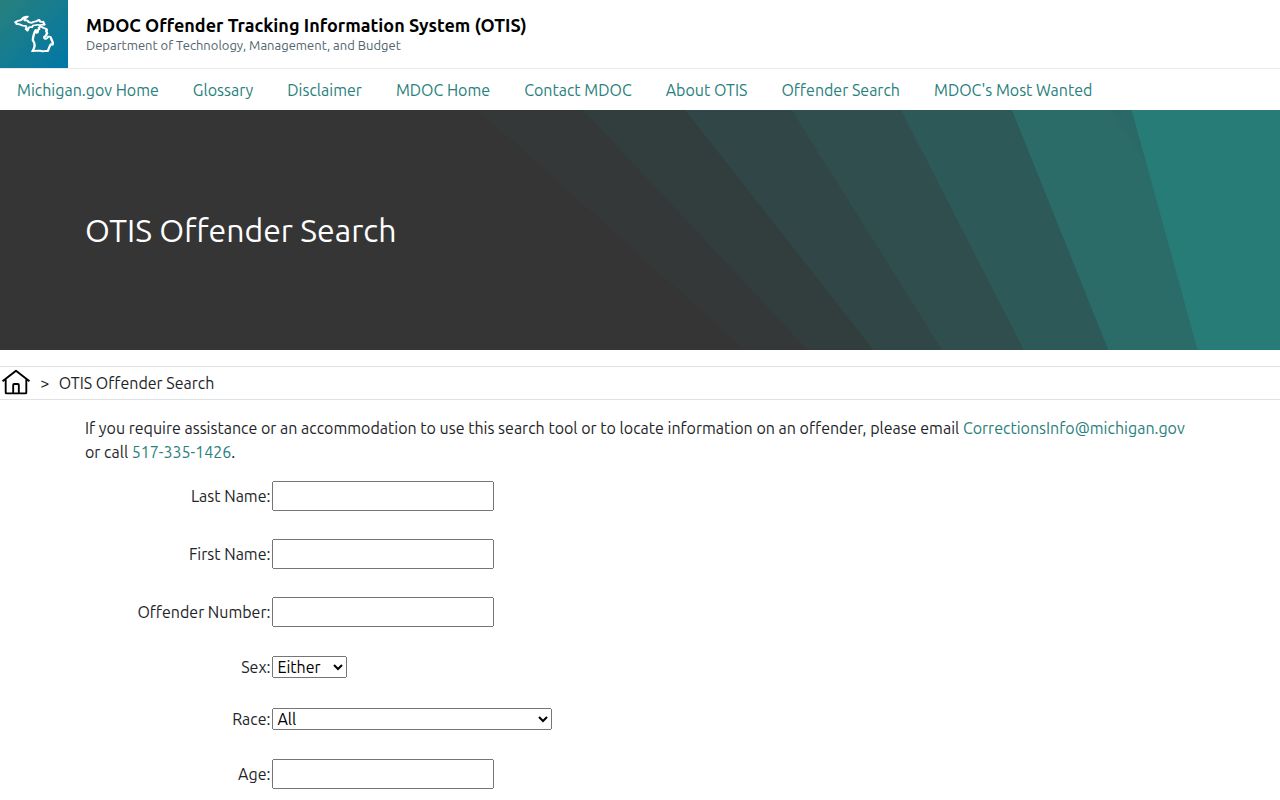
The form’s status and identity fields help prevent a county-jail-only case from being mistaken for an MDOC record.
Gratiot Release Records Across Courts
Gratiot criminal records split between two courts. The 65B District Court search covers misdemeanors and the early stages of felony cases. The 29th Circuit Court search holds the felony disposition after bindover. Search both when the charge level or case path is uncertain.
A dismissal, bond, time-served sentence, or probation entry can explain legal authority for release. It does not replace the Sheriff’s physical-exit time. MiCOURT is informational and omits nonpublic records. Some data may be time-filtered. Older Gratiot files can require the public terminal, manual indexes, or a clerk copy request under court rules rather than county FOIA.
Can a closed court case prove jail release? No. “Closed” describes the case posture. Match the order or judgment with the jail custody record.
Gratiot County Monitored Release
The Gratiot Office of Community Corrections gives local courts and the Sheriff a monitored option that can ease jail crowding. A person may leave the jail on electronic monitoring and remain on house arrest, with permission needed for approved activity. That is a physical jail release, not unrestricted liberty or the end of the case.
Regional mental-health and sobriety courts add structured community paths. They are supervision programs, not release locators. Confirm the jail exit with the Sheriff, then read the court or OCC record for the limits that follow. OTIS may cover felony probation assigned to MDOC, while local district probation follows its own court route.
Equipment Fees After Gratiot Release
OCC states that monitored-release participants pay daily equipment fees and gives a GovPay payment route. It does not publish one universal amount. The exact obligation must come from the participant’s order or OCC, not an estimate.
This local fee is another reason a name can leave JailTracker while restrictions continue. Payment records do not prove full case discharge. Pair the Sheriff’s release disposition with the court or OCC supervision record.
ICE Transfers After Gratiot Release
An ICE detainer can turn a county release into a transfer. ICE may ask for advance notice and request custody for up to 48 hours beyond the point when the person would otherwise be released so federal immigration authorities can act. If ICE takes custody, the Gratiot jail exit is real, but community release has not occurred.
The ICE detainee locator covers current detainees and recent ICE releases for a limited period. No official Gratiot ICE contract or dedicated ICE facility was found, so this is a conditional route. It should be used only when the county record, court file, or known detainer points toward immigration custody.
Set-Asides and Gratiot Release Searches
A blank result can reflect law and retention, not a clean answer. Gratiot’s local expungement information directs readers to Michigan guidance and Legal Services of Eastern Michigan at 800-322-4512. Eligible conviction information can become nonpublic after a set-aside. OTIS also removes a matching profile when directed by the sentencing court or by operation of law.
Michigan FOIA begins at MCL 15.231, while court access follows MCR 8.119 because the judiciary is outside the FOIA public-body definition. Juvenile, sealed, set-aside, victim, medical, investigative, and security material can be withheld or redacted. A missing roster, OTIS profile, or MiCOURT result never proves release by itself.
Where Each Gratiot Record Lives
Released and current-custody information belongs to the agency that created it. Matching the population to the system prevents a common false conclusion.
| Situation | Current source | Release or history source |
|---|---|---|
| Gratiot County Jail detainee | JailTracker roster | Sheriff call, custody record, court order |
| MDOC prisoner | OTIS prisoner status and location | Date Paroled, Discharge Date, MDOC records |
| County supervised release | Court or OCC terms | Jail disposition plus court program record |
| Federal BOP prisoner | BOP location | Past Release Date with location RELEASED |
| ICE custody | ICE ODLS | ODLS limited recent-release result and paperwork |
MI-VINE can add timely notice when the agency participates, but it is not a historical release ledger. Save event details and request the official record when the timestamp or destination must last.
Gratiot Release Alerts and Federal Checks
VINELink is Michigan’s public route to MI-VINE custody information and notifications. A participating county jail can report release, transfer, or escape events. MDOC uses a separate state-prison tier for general release notice, and direct victims may enroll with the MDOC Crime Victim Notification Unit for added parole information. No static official source conclusively confirmed that Gratiot County Jail is feeding the live service. Find the Gratiot agency in VINELink or call 800-770-7657 before relying on an alert. A “released” event confirms departure from the reporting agency, not freedom from every custodian.
Federal cases require another branch. The BOP Inmate Locator can show a past Release Date with location “RELEASED,” which confirms departure from BOP custody. It does not rule out federal supervised release, state custody, or ICE custody. Federal pretrial detainees may be held under U.S. Marshals Service authority and never appear as ordinary BOP prisoners. Since USMS has no public released-prisoner name database, use the federal court docket and release order for that event. These federal paths are conditional for Gratiot County because no federal prison is mapped within the county.
Gratiot County Release Facilities
Three detention facilities define the local landscape. Physical location in Gratiot County does not mean county custody. The jail in Ithaca is operated by the Sheriff. The two prisons in St. Louis are operated by MDOC and use statewide release records.
- Gratiot County Jail holds county detainees; releases can lead to the community, monitoring, or another custodian.
- Central Michigan Correctional Facility is a Secure Level I state prison; OTIS and MDOC records document parole or discharge.
- St. Louis Correctional Facility is a Level IV state prison; a changed location can be a transfer rather than release.
Gratiot County Jail has a 70-person capacity and underwent a major renovation in 2001. Central Michigan opened in 1990 and MDOC reports 2,560 places in 16 dormitory-style units. St. Louis opened in 1999 on a 67-acre site. Those facts explain why the agency name matters as much as the county name.